Saudi partners weigh defence support as Houthi attacks intensify
Saudi, Turkish and Pakistani military leaders are preparing talks under a defence pact as Yemen’s Houthis target Saudi Arabia. Restrictions on Iranian flights have also spread, while Tehran has warned of retaliation and offered terms for ending the wider conflict.
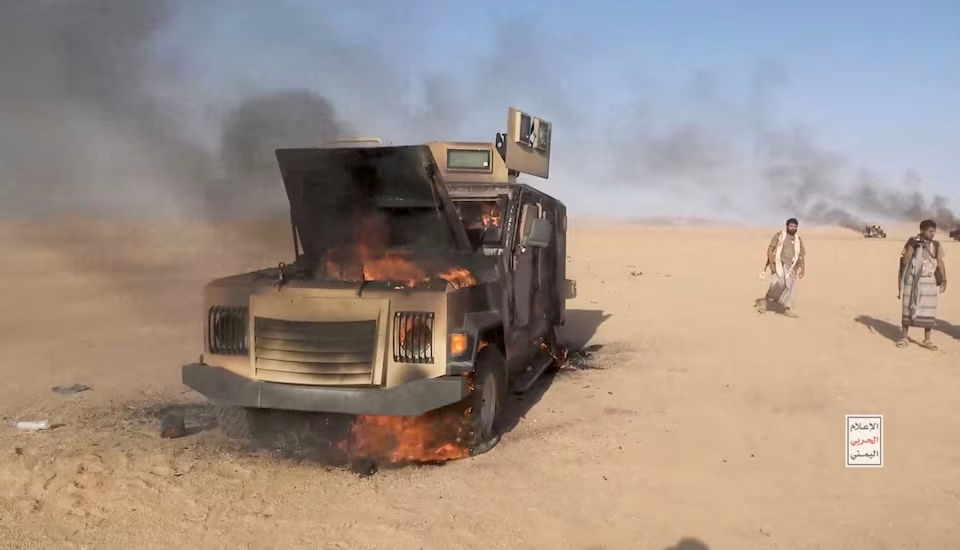
Military chiefs from Saudi Arabia, Turkey and Pakistan are expected to discuss support for the kingdom as attacks by Yemen’s Houthi movement escalate. The talks follow a meeting of the three countries’ foreign ministers on Thursday, held under a defence agreement signed in August. Turkey’s Defence Ministry said General Selcuk Bayraktaroglu, its chief of general staff, was headed to Saudi Arabia on Friday for discussions with the kingdom’s and Pakistan’s senior military officers.
Turkish President Tayyip Erdogan described the agreement as a mutual-defence pact: an assault on one member is treated as an assault on all. Possible assistance could involve intelligence, logistical help or ammunition, he said, while more sophisticated military backing would depend on the threat’s scale. The Houthis, aligned with Iran, said Thursday they had launched dozens of missiles and drones at Saudi targets. Saudi authorities reported intercepting six ballistic missiles.
The attacks have added pressure on Saudi Arabia, which backs Yemen’s internationally recognised government. Rashid al-Alimi, the government’s Riyadh-based president, urged Yemenis on Friday to enlist in the armed forces and offered amnesty to Houthi fighters who abandon the group. The Houthis have intensified operations against government forces and struck Saudi territory, contributing to disruption of oil flows from the world’s largest crude exporter. Fighting has also deepened Yemen’s humanitarian crisis as efforts to secure a ceasefire remain stalled.
The conflict is part of a wider regional war, now in its eighth month, that began with U.S.-Israeli strikes on Iran on February 28. Thousands have been killed and trade and energy supplies have been disrupted. Direct exchanges between Washington and Tehran have ebbed and resumed, while allied groups have opened other fronts: Hezbollah attacks led to an Israeli invasion of Lebanon, and Houthi advances have worsened conditions in Yemen. Iran has constrained tanker movement through the Strait of Hormuz, formerly used for about one-fifth of global oil exports, while Houthi actions have disrupted shipping near the Red Sea entrance.
Washington has increasingly sought to pressure Iran economically, including through secondary sanctions on overseas businesses dealing with Iranian companies. New U.S. sanctions have prompted neighbouring states—the United Arab Emirates, Oman and Iraq among them—to prohibit Iranian airlines from operating or accessing their airports. The restrictions mark a major early consequence of the measures. If sustained, the flight bans could further isolate Iran and aggravate an economy already under strain from Washington’s blockade of Iranian seaports.
Mohammad Mokhber, an adviser to Iran’s supreme leader, condemned the regional governments’ decision to deny flights, saying they were aligning themselves with the United States. In a social media post, he warned that if Iran could neither fly nor use airport facilities, other countries in the region would also lose that possibility. Separately, U.S. Ambassador to China David Perdue said President Donald Trump told Chinese President Xi Jinping at the White House that any Chinese support for Iran would be unacceptable. Perdue said that warning covered direct or indirect assistance, including intelligence, components and military equipment. China is Iran’s largest trading partner and a significant purchaser of its oil.
Iranian Foreign Minister Abbas Araqchi said in New York on Thursday that Tehran had sent Washington a proposal through intermediaries. He said it would reopen the Strait of Hormuz if Iran’s conditions were met: hostilities on every front, including Lebanon, would end within seven days, and the United States would lift its port blockade, unfreeze Iranian funds and waive oil sanctions. A senior Iranian official said Friday that Tehran would not compromise on its nuclear programme even if Washington accepted the proposal. Oil prices fell by more than 2.5% on Friday, as hopes for a U.S.-Iran truce outweighed concern that escalating Houthi attacks might further threaten supplies. The official also threatened retaliation over the flight restrictions, underscoring the risk that diplomatic and economic pressure could widen the confrontation.