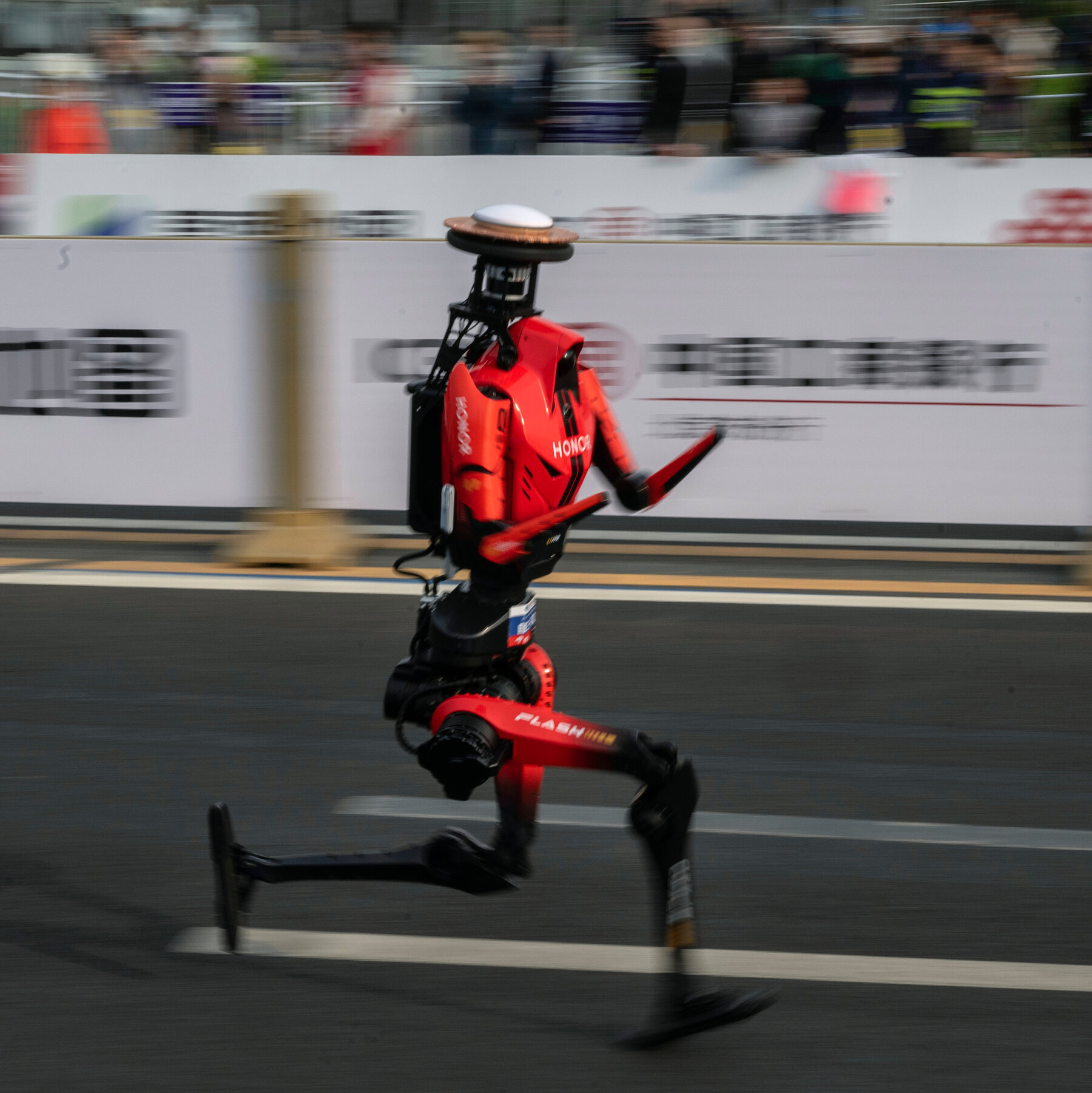
Robotic Prowess Redefines Endurance: Android Achieves Unprecedented Running Speeds in Beijing
A recent competition in Beijing showcased a remarkable leap in robotics, as an advanced humanoid android achieved a monumental feat during a timed half-marathon. This machine did not merely participate; it established a new benchmark in human-machine endurance by completing the race in a time that surpassed the fastest recorded human performances. The event, structured as a crossover competition involving both bipedal robots and human athletes, immediately drew significant attention for the implications of such technological milestones in athletic disciplines.
The performance signals a growing convergence point between advanced engineering and physical performance standards. While the race format was designed to pit robotic capabilities against peak human athleticism, the android’s time provided clear evidence of a different, perhaps more efficient, form of movement. This achievement moves the narrative beyond mere participation and into the realm of redefining what ‘record’ means in modern endurance sports.
What This Means: The Future of Mechanized Performance
The primary significance of this event lies in the tangible proof of the trajectory of humanoid robotics. By achieving speeds previously thought unattainable for motorized bipedal systems over sustained distances, the android provides critical data points for machine learning and biomechanical engineering. It suggests that robotic designs are rapidly approaching, and in some metrics surpassing, natural human limitations. This has profound implications across several sectors, suggesting that mechanical augmentation could revolutionize everything from marathon running to demanding labor tasks.
Experts suggest that future developments will focus on translating these steady advancements into practical, real-world applications. The success of the machine demonstrates breakthroughs in power-to-weight ratio, energy efficiency, and navigating varied terrain over extended periods. Rather than just being a novelty, this marks a significant stride toward integrated electromechanical systems capable of sustained, high-output performance comparable to elite human athletes.
Background and Context: Merging Man and Machine Limits
Historically, competitive robotics have often been siloed from human sports, treating them as separate fields of study. This specific event, however, intentionally blurred those lines, creating a unique proving ground. The objective was evidently to benchmark the physical capabilities of emerging artificial intelligence platforms against the gold standard of human physical conditioning. For the robotics community, such an opportunity provides invaluable stress-testing conditions that cannot be replicated in controlled lab environments.
Furthermore, the broader context involves the accelerating pace of AI integration into physical goods. As these machines become more robust and their algorithms more refined, the gap between theoretical engineering and practical, competitive performance narrows daily. The demonstration in Beijing underscores a key industrial trend: the application of sophisticated computation to solve complex, physical movement problems with unprecedented efficiency. It serves as a powerful indicator that the mastery of repetitive, energy-intensive motions is quickly transitioning from the sole domain of biology to that of highly advanced computation.
About the Author