Nationwide Demonstrations Mark Workers’ Day Calls for Systemic Economic Change
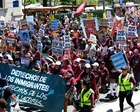
In a coordinated effort spanning multiple locations across the country, thousands of individuals participated in demonstrations marking International Workers’ Day. These large-scale gatherings featured marches, organized walkouts, and block events, conveying a unified message demanding significant shifts in economic structures. The scope of the activity was broad, encompassing calls for a widespread cessation of normal economic activity—suggested by slogans advocating for ‘no school, no work, no shopping’—to draw attention to labor concerns and economic inequality.
The actions varied in format, from public assemblies outside major financial institutions to localized protests in city centers. In one notable instance, activists staged direct actions near a major financial exchange, physically occupying areas to draw attention to their cause. These efforts were part of a broader movement involving tens of thousands of people coordinating demonstrations to put pressure on established economic systems and highlight the perceived disconnect between wealth accumulation and worker welfare.
What This Means: A Call for Systemic Overhaul
The nature of these demonstrations suggests that the participants are not focused merely on minor policy adjustments. Instead, the coordinated call for a temporary halt to commerce and daily routines implies a fundamental disagreement with the current economic paradigm. When activists advocate for ceasing participation across multiple sectors—education, labor, and consumerism—they are signaling that the perceived problems are systemic. The central themes emerging from these protests revolve around wealth disparity and the need for restructuring how economic power is distributed throughout the nation.
Background and Context
Historically, International Workers’ Day has served as a focal point for labor movements globally. This year’s actions built upon established traditions of public assembly, utilizing modern forms of civil disobedience to maximize visibility. The focus on financial centers, for example, reflects a long-standing protest tactic designed to draw the attention of corporate and governmental power structures directly into the protest narrative. The continuous presence of chants and slogans directed at wealth concentration underscore the deep-seated political and economic grievances fueling the nationwide mobilization.
About the Author