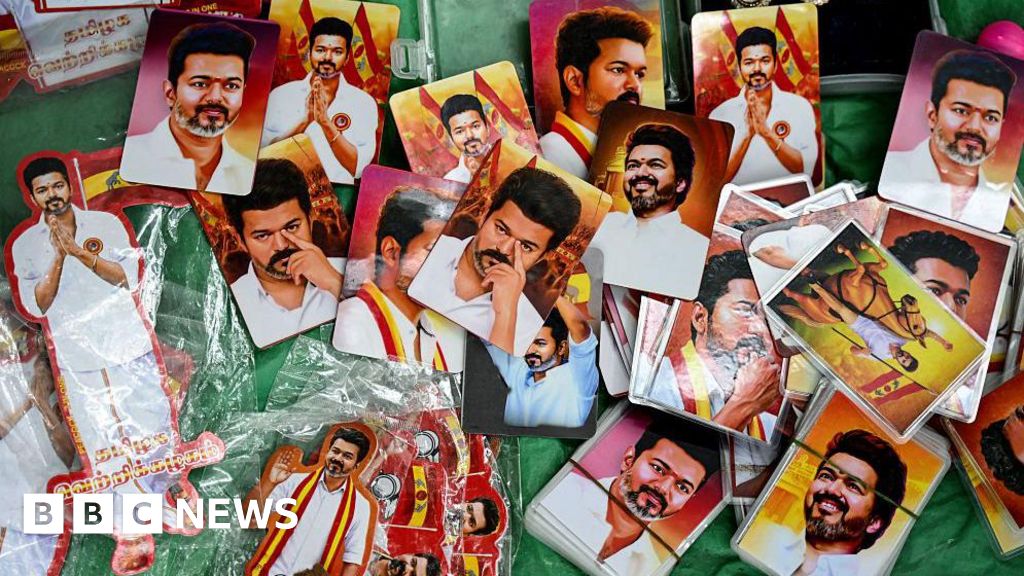
The political landscape of Tamil Nadu is experiencing a potential seismic shift, spearheaded by the emergence of film star C Joseph Vijay and his newly formed party, Tamilaga Vettri Kazhagam (TVK). This development represents a notable disruption to the long-standing duopoly that has characterized the state’s political arena, which has traditionally seen voters choosing between two major regional outfits. Vijay’s performance in the recent elections has been nothing short of spectacular, causing considerable ripples of excitement among supporters and sending ripples of surprise through the established political structures.
Vijay’s trajectory has drawn comparisons to landmark moments in Tamil Nadu’s political history, specifically drawing parallels to the career arc of cinema legend MG Ramachandran, who previously forged a path to power by creating a distinct political entity separate from the dominant Dravida Munnetra Kazhagam. While his immediate electoral showing is cause for celebration, the path to forming a state government remains complex. To claim a majority in the 234-member assembly, a significant number of legislative seats are required, and securing the support of several smaller groups and independent members will be crucial in the coming days.
Beyond the raw electoral numbers, analysts suggest that Vijay’s influence stems from a unique blend of public persona and political messaging. Observers have noted that his appeal seems rooted in an aura of confidence and a distinct, individualistic appeal that transcends conventional political rhetoric. This is further evidenced by his deliberate public activities, including highly visible engagements with various religious sites. In a region whose modern political foundation is often credited to rationalist social movements, this palpable emphasis on faith suggests a carefully calculated strategic maneuver.
The Significance of the Shift
This unfolding drama signifies more than just a change in leadership; it represents a potential redirection of the state’s political ideology. Tamil Nadu has a historical association between its cultural icons, its cinematic storytelling, and its political outcomes. From past figures who successfully translated screen charisma into state governance, Vijay steps into this celebrated but volatile tradition. His ability to mobilize support through cultural cachet, combined with the need to build a broad coalition, places him at a pivotal juncture—transforming from a popular draw into a master negotiator required to stitch together a working government. The coming days will reveal whether this individualistic appeal can successfully translate into enduring political power, fundamentally altering the dynamics for years to come.
About the Author