The Emerging Frontier: Commercializing the Depths of the Ocean Floor
The vast, largely unexplored depths of the world’s oceans are becoming a focal point for emerging industrial ventures. As terrestrial reserves of vital metals dwindle and the demand for technology components grows, private and public entities are increasingly eyeing the seafloor as a massive, untapped mineral source. This pursuit centers on retrieving valuable elements, such as rare earth minerals, cobalt, and manganese, which are critical inputs for modern technology—from electric vehicle batteries to advanced electronics. The prospect of this oceanic bounty promises a significant boost to global supply chains and industrial economies.
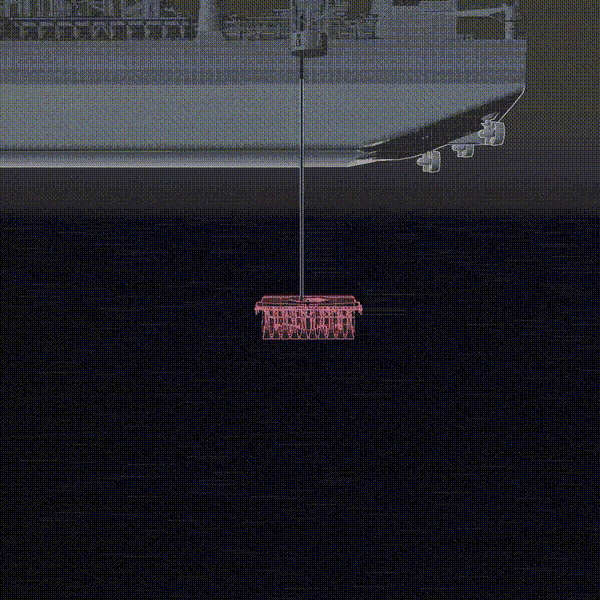
These operations are not simply about extraction; they represent a fundamental shift in resource acquisition. Instead of terrestrial mining, the focus is on polymetallic nodules found scattered across abyssal plains, as well as deposits associated with hydrothermal vents. The technological scale required for such ventures is immense, necessitating specialized, large-scale machinery capable of operating under extreme pressure, total darkness, and corrosive conditions. Companies involved are developing sophisticated robotic mining systems designed to collect these nodules or process mineral-rich crusts directly from the seabed.
Understanding the Impact of Seabed Extraction
While the potential economic rewards are substantial, the environmental implications of large-scale deep-sea mining are subjects of intense scientific and ethical debate. The primary concern revolves around the potential disruption to deep-sea ecosystems. These environments have evolved over millennia in relative isolation, supporting unique and often slow-growing biodiversity. The physical act of machinery traversing and removing sediment could fundamentally alter benthic habitats.
Beyond habitat destruction, the operational discharge from these mining activities presents another major worry. These plumes—composed of fine sediment, disturbed water, and potentially processed effluent—could drift significant distances, smothering nearby organisms and altering the chemistry of the water column. Furthermore, the noise pollution generated by heavy machinery operating continuously at depth could interfere with the communication and feeding patterns of deep-sea fauna, including cetaceans and commercially important fish stocks.
Scientific Scrutiny and Global Governance
The current global framework for regulating deep-sea mineral extraction is complex and still evolving. International bodies are working to establish comprehensive regulations that attempt to balance the need for critical raw materials with the imperative of conservation. Scientific bodies emphasize the need for precautionary measures, advocating for thorough baseline studies before any large-scale removal begins. Researchers are urging a deeper understanding of deep-sea biological connectivity—how life moves between different parts of the ocean—to accurately assess the true scope of potential damage.
The dialogue surrounding this industry is thus characterized by a tension between technological ambition and ecological responsibility. While the drive for minerals is fueled by the demands of the green energy transition itself, the methods proposed for acquiring these materials threaten to undermine the stability of some of the planet’s least understood, yet most vital, biomes. Continued scientific monitoring and the establishment of robust, enforceable environmental safeguards remain paramount for any future deep-sea industrialization.
About the Author